
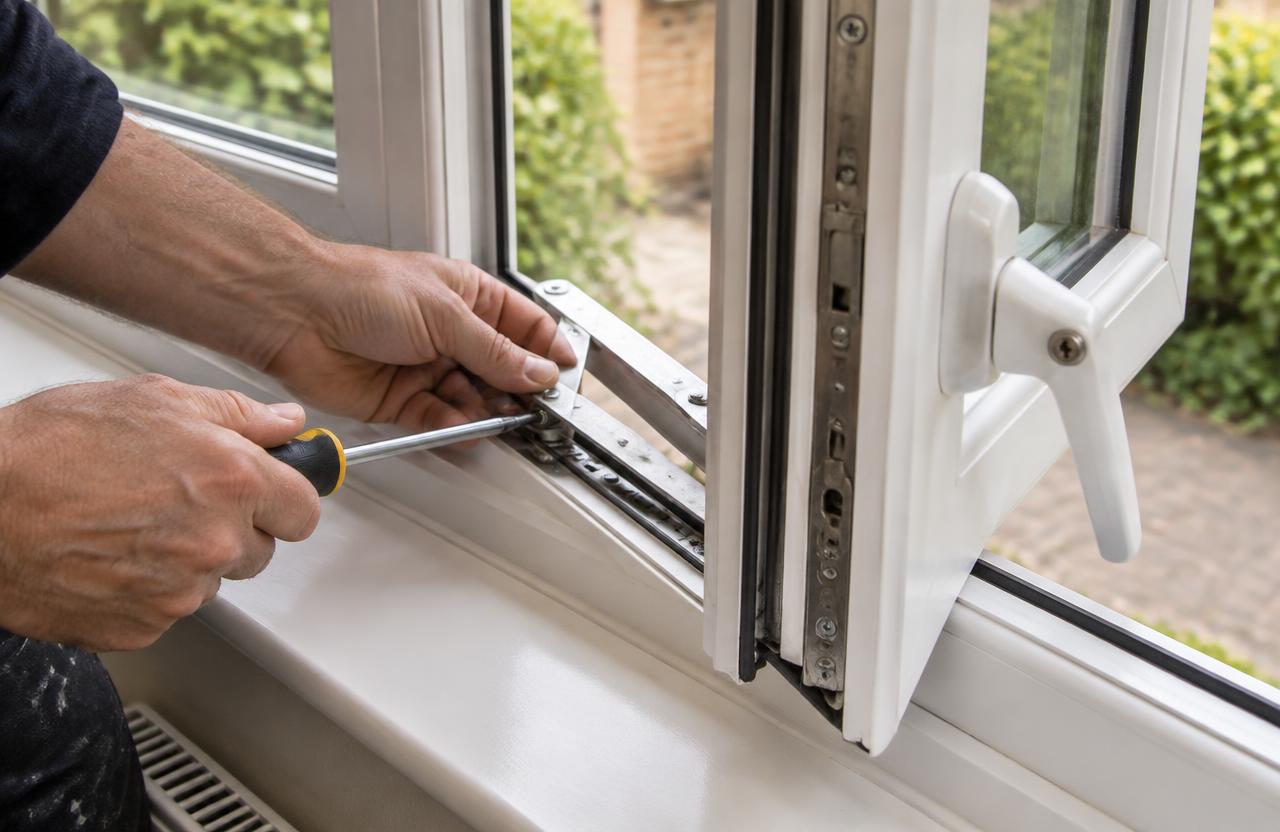
The short answer: when a uPVC window won't close, won't lock or the handle has gone floppy, the frame and glass are almost always fine. The problem is nearly always one of four parts: the handle, the locking gearbox, the hinges or the lock keeps. Each can be replaced on its own, usually in a single visit, for a small fraction of the cost of a new window.
Match Your Symptom to the Fault
| What you notice | Most likely cause | The usual fix |
|---|---|---|
| Handle turns but the window won't lock or open | Worn or broken gearbox inside the frame | New espagnolette gearbox |
| Handle is loose, floppy or snapped | Worn handle or loose fixing screws | Tighten or replace the handle |
| Window catches the frame at the bottom corner | Hinges worn, so the opening part has dropped | New pair of friction hinges |
| Window won't stay open, or swings in the wind | Hinges have lost their grip | Adjust or replace the hinges |
| Handle is very stiff to lock | Locking points out of line with the keeps | Adjust keeps and hinges |
| Key won't turn in a lockable handle | Failed lock barrel in the handle | New lockable handle |
| Window is stuck shut and the handle won't move | Seized or broken gearbox | Specialist opening and new gearbox |
| Draught around the opening edge | Squashed seals or loose hinges | New seals and hinge adjustment |
| Glass is misty between the panes | Failed sealed unit, not a hardware fault | New sealed unit in the same frame |
Three Safe Checks Before You Call Anyone
1. Try the handle gently, both ways
Never force a stiff handle. A handle that fights you is usually caught on a lock keep, and heaving on it is exactly how gearboxes break and handles snap off. A handle that turns freely but does nothing has lost its grip on the gearbox. A handle that stops halfway means the locking points are jammed.
2. Look down the opening edge with the window open
Along the edge of the opening part you will see a metal strip with small round locking points. On the frame there are matching metal keeps. Close the window slowly and watch. If the locking points hit the keeps instead of sliding behind them, the window has dropped or the keeps have moved.
3. Check the hinges at the top and bottom
Open the window fully and look at the metal arms. Broken rivets, bent arms or a gritty, crunching feel mean the hinges are worn out. If a hinge looks cracked on an upstairs window, keep it closed until it is fixed, as a failed hinge can let the whole opening part drop.
What You Can Safely Do Yourself
- Clean and lubricate. Wipe the locking strip and hinge tracks, then use a light silicone spray. Avoid thick grease, which collects grit and makes things worse.
- Tighten the handle. Lift or twist the small cover at the base of the handle and tighten the two screws. A surprising number of floppy handles are just loose.
- Adjust a keep. Many keeps have a small adjuster. A quarter turn can turn a stiff handle into a smooth one. Mark the starting position first.
- Swap a handle. Most espagnolette handles use two screws at a standard spacing. Take the old one with you, as the spindle length and fixing must match.
Leave gearboxes, hinges and windows that are stuck shut to someone with the right parts. Hinges must be matched to the frame by length and height, and a window that is locked shut has to be opened in a particular way to avoid damaging the frame. Our guide to stopping draughts from uPVC windows covers adjustment in more detail.
The Parts Explained in Plain English
Handles
Most modern uPVC windows use an inline espagnolette handle with a square spindle that goes into the frame. Older windows may have a cockspur handle that hooks onto a wedge on the frame. Handles come in different spindle lengths and in lockable or non-lockable versions, and we can usually match the style and finish of the others in your home.
The gearbox (espagnolette lock)
This is the hidden mechanism behind the handle that drives the locking strip up and down. It is the single most common reason a handle spins or a window won't lock. Gearboxes come in different sizes, so the old one is measured before a new one is fitted.
Friction hinges
Despite the name, these carry the whole weight of the opening part and control how stiffly it opens. After 10 to 15 years the rivets and slides wear, the opening part drops, and it starts catching the frame. They are replaced in pairs and must match the frame by length and height.
Fire escape hinges
Upstairs bedroom windows often need hinges that open wide enough to climb out in a fire. If your windows have them, replacements must be the same type. We always check this rather than fitting a standard hinge.
Keeps and restrictors
Keeps are the metal catches on the frame that the locking points slide behind. Restrictors limit how far a window opens, which is useful for children's rooms. Both are quick to replace or add.
What Does a uPVC Window Repair Cost in 2026?
Typical UK fitted prices published in 2026 look like this. Most firms have a minimum call-out, so combining jobs in one visit is the easiest way to save money.
| Repair | Typical UK price, fitted |
|---|---|
| Window handle replacement | £60 to £110 |
| Pair of friction hinges | £80 to £150 per window |
| Espagnolette gearbox or locking mechanism | £120 to £250 |
| Seals renewed | £50 to £120 per window |
| Misty sealed unit replaced | Depends on size, see our instant price calculator |
Compare that with a new uPVC window, which typically runs well into the hundreds of pounds per window before fitting extras. For a window with a sound frame, a repair saves you hundreds, and often more than a thousand pounds across a house.
When Is It Worth Replacing the Window Instead?
Repair is the right answer most of the time. Replacement only makes sense when:
- The frame itself is cracked, warped or badly discoloured
- The window is so old that parts are no longer made for it
- Several windows have multiple faults at once and the repair bill is closing in on the price of new ones
If you are unsure, read our honest guide to repair versus full replacement, or send us a photo and we will tell you straight.
Don't Leave It: Why Window Faults Matter for Security
A window that won't lock is an open invitation, and it may also affect your home insurance. Many policies expect accessible windows to have key-operated locks, so a broken lock could matter if you ever need to claim. Check your policy wording. A window that won't close properly also lets in draughts and damp, which can mark the frame and walls over time. For more ideas, see our window security tips.
How We Fix It
- Send a photo. A picture of the handle, the hinges and the edge of the window, plus your postcode, usually tells us the fault before we arrive.
- We diagnose on site. We check the whole window, not just the obvious part, so the same fault doesn't come back next month.
- Fit and adjust. Common parts come on the van, so most repairs are done in one visit. Some specialist locks have to be ordered in, and we will tell you up front if that is likely.
- Test. Every window is opened, closed and locked several times before we leave.
If one of your windows also has misty glass, we can replace the sealed unit on the same visit. Not sure? Here is how to tell if your double glazing has blown.
Get Your Window Working Again
We repair uPVC and aluminium window handles, locks and hinges across Basildon, Billericay, Brentwood, Chelmsford, Wickford, Southend, Romford, Hornchurch and the surrounding towns. Visit our window handles, locks and hinges page or ask for a free quote.