
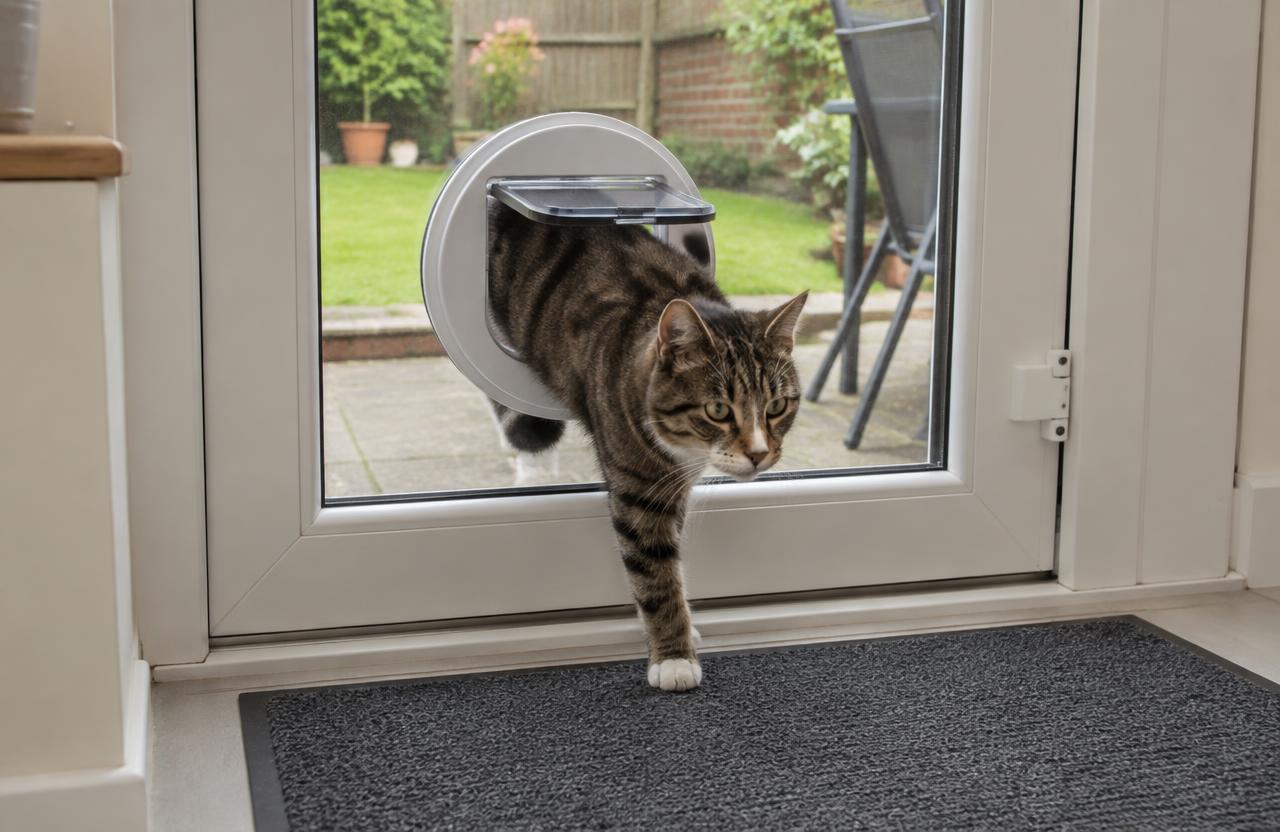
The short answer: yes, you can have a cat flap in a glass door, a patio door or even a double glazed window. What you cannot do is cut a hole in the glass that is already there. A new sealed unit is made with the hole built in, it goes into your existing frame, and the flap is fitted into it. Your door, frame and locks stay exactly as they are.
Can You Put a Cat Flap in a Glass Door?
Yes, and it is one of the neatest ways to give a cat its own way in and out, especially when the only door to the garden is a glazed patio, French or back door. The flap makers all say the same thing about existing glass, though: it cannot be cut on site. Sure Petcare, PetSafe and Cat Mate all state that existing toughened or double glazed panels need replacing with a new panel made for the flap.
So when a glazier quotes you for "a new unit" to fit a cat flap, they are not upselling you. That is simply the only safe way to do it.
Why Your Existing Glass Can't Be Cut
There are two reasons, and either one is enough on its own.
- Door glass is almost always toughened. Building Regulations class glass in a door as a critical location, so it must be safety glass. Toughened glass is held under tension. Try to drill or cut it and the whole pane bursts into small pieces. Any hole has to be cut before the glass goes through the toughening furnace.
- A double glazed unit is sealed. The two panes are joined by a spacer bar and sealed round the edge to keep the gas in and moisture out. Cut through it and the seal is broken for good, and the unit will go misty within months.
If anyone offers to cut your existing door glass in place, be cautious. At best the glass shatters and you pay for a replacement anyway. At worst you end up with a misty, weakened unit in a door.
How a Cat Flap Is Fitted Into Double Glazing
The job is done in two short visits, with the clever part happening at the glass factory in between.
- Survey and choice of flap. We measure the existing glass, check whether it is toughened or laminated, and agree which flap you want. If you have already bought one, keep the box and the fitting template, as we need the exact hole size.
- Agree the position. We mark where the flap will sit, at the right height for your cat and with enough glass left around the hole to keep the unit strong.
- The new unit is made. The hole is cut through both panes before toughening. A round spacer is then sealed around the hole inside the unit, so it stays airtight just like a normal sealed unit.
- Fit. We take out the old glass, fit the new unit in your existing frame, replace the beads and fit the flap into the hole with its glass mounting kit.
- Test. We check the flap swings cleanly, the seals close and the door still shuts and locks properly. For a microchip flap we can help you register your cat's chip before we leave.
Fitting day itself is usually about an hour per door. The unit is made to order, so allow roughly a week between survey and fit.
Where Can the Cat Flap Go?
| Location | Is it suitable? | How it is done |
|---|---|---|
| Back door with a glass panel | Yes, very common | New toughened sealed unit with the hole built in |
| French doors | Yes | Usually the less used leaf, so the cat's door stays shut more often |
| Sliding patio door | Yes | Normally the fixed pane, so the flap never slides behind the opening one |
| Bi-fold door | Often | Depends on the pane size and how the doors fold and stack |
| Double glazed window | Yes, with steps or a ledge | Same as a door, and your cat needs a safe step on both sides |
| Solid uPVC door panel | Yes, simplest option | The panel is cut, or swapped for a pre-cut one |
| Composite door | With care | Cutting the door slab can void its warranty, so the glass is often the better spot |
| Fire door | No | Altering a fire door breaks its rating |
Getting the Height Right
This is the detail most people don't think about until it is too late, and once the glass is toughened the hole cannot be moved.
- Belly height. The bottom of the flap should sit roughly level with your cat's belly, so they step through rather than jump or crawl. Measure your cat standing, from the floor to the underside of the tummy.
- Check both sides. If the outside step or patio is lower than your kitchen floor, the drop on the way out may be bigger than it looks. A small step outside solves this.
- Leave enough glass round the hole. Glass factories need a minimum margin between the hole and the edge of the pane, often around 100mm. On a small door panel that can limit how low the flap can go, so we check this at survey.
- Think about older cats. A cat with stiff joints will thank you for a lower flap and a mat on both sides.
Choosing a Cat Flap for Glass
Not every cat flap is made to go through glass. You need a model that fits a round hole and comes with, or accepts, a glass mounting kit. Buy or choose it before the unit is ordered, because the hole size varies by brand and model.
- Manual flaps. The cheapest option, with a simple lock. Fine if there are no other cats nearby.
- Magnetic or collar-key flaps. Open only for a tag on your cat's collar. Collars can get lost, so these are less popular now.
- Microchip flaps. Read the chip your cat already has, so neighbourhood cats stay out. This is the type most of our customers choose. They run on batteries, so pick one with a low-battery warning.
- Small dog flaps. Possible in larger glass panels. The bigger the flap, the more glass you need around it, so we check the pane size first.
We can supply the flap or fit one you have already bought. Either way, we confirm the exact model before the glass is ordered.
How Much Does a Cat Flap in a Glass Door Cost in 2026?
Typical UK prices published by trade cost guides in 2026 look like this. The flap itself is usually extra.
| Job | Typical UK price, fitted |
|---|---|
| Cat flap in a solid uPVC door panel | £80 to £130 |
| Cat flap in a glass or double glazed door | £150 to £250 |
| Larger pet flap in a glass door | Around £250 |
| Cat flap through a brick wall | £200 to £450 |
| The flap itself: manual | £10 to £30 |
| The flap itself: microchip | £50 to £150 |
What moves the price for glass:
- Pane size. A full-height patio pane costs more to make than a small back door panel.
- Glass type. Obscure, laminated or Low-E glass all add a little.
- Triple glazing. Possible, but the flap needs a longer tunnel or extension kit.
- Doing it at the same time as other work. If another pane in the house is already misty, fixing both in one visit saves you a second call-out.
If your door glass is already misty or cracked, a cat flap unit is a smart way to fix the problem and add the flap in one go, for little more than the cost of the replacement glass alone.
Security and Insurance
- Tell your insurer. Some policies ask about pet flaps, especially in doors. It is a quick call.
- Keep the flap away from the lock. A hole within arm's reach of the key or handle is a risk. Set the flap low, and never leave keys in the door.
- Choose microchip. It keeps other cats, and the odd fox, out of your kitchen.
- The glass stays safety glass. Your new unit is still toughened, so it meets the same rules as the glass it replaces.
What If You Move or No Longer Need It?
Because the flap lives in its own sealed unit, it is easy to undo. We can swap it back for a plain unit to match the rest of the door, which is handy if you are selling, or if your cat is no longer with you.
Get a Price for Your Cat Flap
The quickest way is to send us a photo of the door and your postcode, plus the flap model if you already have one. We fit cat flaps into glass doors and windows across Basildon, Billericay, Brentwood, Chelmsford, Wickford, Southend, Romford, Hornchurch and the surrounding towns. Find out more on our cat flap and pet door page, or ask for a free quote.
Already got a misty or cracked panel in the same door? Read our door glass replacement guide and we can do both together.